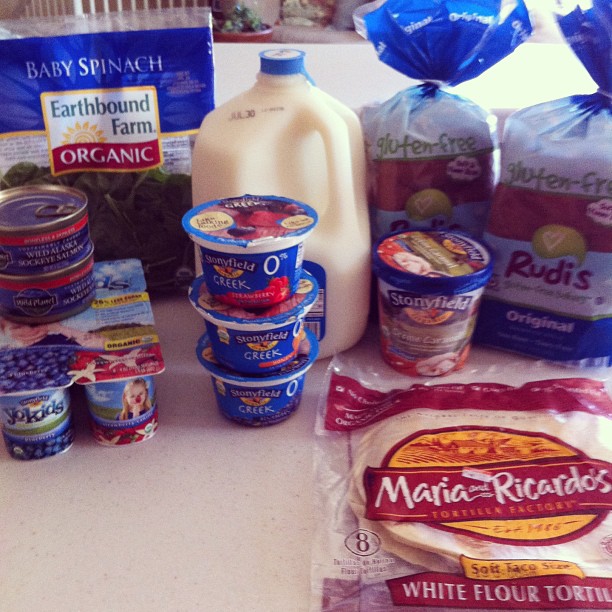
If your family is like mine, groceries are a major part of your budget, so it is essential to take several steps to stretch your grocery shopping budget. Remember when I paid $1 for $30 worth of groceries at Whole Foods – well, Eben and I did it again yesterday, this time we spent $2 on $46 worth of groceries (above photo). Here are the ten steps that my family takes to make our grocery shopping trips as healthy, sustainable and budget-friendly as possible.
1. Create a Grocery Shopping Budget:
When you have a set amount of money that you can spend on groceries it takes the guess work out of “how much did I spend?” It gives you the option to make better choices and to decide what grocery items are sustainable, healthy, necessary, and affordable. We try to only go grocery shopping twice a month, so we divide our monthly budget in half. Just remember to save enough money from your budget, so when you have to stop to pick up fresh fruit, vegetables, bread and milk in between grocery trips, it won’t take you over your budget.
Sit down with your family and discuss what meals they would like to have for breakfast, lunch and dinner. Also, discuss the snacks and beverages that you would like to have stocked in your pantry. Remember to take school box and work lunch meal plans into consideration when creating your meal plan and list. By creating a meal plan, you will know exactly what items you need to prepare the meal and you won’t have a hard time deciding what is for dinner. This will lessen the chance of everyone jumping into the car for a fast food run. If you need help planning meals, you can check out one of my favorite websites Supercook, which allows you to enter the ingredients that you have on hand and then it will generate recipes that you can make with those ingredients.
There are many great online services where you can print or order your own natural and organic food and product coupons. Here are my favorite online resources, I also recommend emailing the companies that you love, tell them and they may send you free coupons! I always combine my free manufacturer coupons with store coupons – this gives me money back to use on another purchase.
When shopping for a bargain, consider the store brand. In many cases the store brand is made for your local store by one of the bigger brand names. For instance, if you shop at a big box warehouse, the store brand organic, fair trade, rain forest alliance certified coffee that you purchase, may very well be made by Starbucks. If your favorite organic cereal, granola bars, soups, snacks or staples are on sale, buy as many as you can afford and stock up. Most of these types of pantry items will keep well for weeks, if not months from the date that you purchased them. You can save a ton of money if you stock up on the items that you would usually buy anyhow. This can work well for meat, poultry, fish and frozen food items that you can bring home, divide up and freeze.
You can save a lot of money by buying organic fruits and vegetables that are in season. In season produce is not only less expensive because of the availability but in most cases this produce tastes the best. When purchasing produce, make sure that you are only purchasing what your family will actually consume before it spoils. This can also apply to other items that you purchase while grocery shopping. It is very Earth friendly to purchase local produce that isn’t shipped halfway around the world consuming enormous amounts of energy in the process. Also, it is a great feeling to support your local agriculture and farmers. Check with your local meat, poultry, dairy and produce farmers to find out if the products that they sell are possible organic but just not labeled as such. Many local farmer’s grow and produce organic products but are unable to afford the organic certification that is required by law.
Utilizing your local big box warehouse is a valuable tool in purchasing fabulous organic and environmentally friendly products at a much better price. If you don’t feel that your family will consume these items in such large quantities, ask a friend or family member to go in halves and then split the products. Buying in bulk is much more friendly on your wallet and bulk items require less packaging and shipping which is also better on the environment. You can purchase loose items such as cereals, teas, spices, coffee, honey, peanut and almond butter, snacks and grains in loose bulk at your local natural grocery store. Our family takes our own containers to refill which saves the environment the plastic bag or container that the store provides.
Let’s face it, organic meat is more expensive, not only on your wallet but on the environment as well. A plant based diet is definitely better on the environment since livestock is the No. 1 contributor of greenhouse gas emission. You can find protein in many foods such as beans, tofu, mushrooms and grains. A good tip is to base your meal on a certain vegetable and built on it from there, instead of making a meat product the main portion of the meal. A good start is to eliminate one meat based meal a week from your diet and replace it with a fabulous vegetarian dish.
The mister does all of the cooking in our home and he makes all of our dressings and marinades from scratch. He has several cookbooks that he loves and utilizes for great dressing and marinade recipes, or he will just whip a new one up. He’s crazy good like that! He says that a lot of dressings and marinades are simple to make and even easy to create on your own without a recipe. Since we almost never purchase bottles of dressings or marinades, we do not have the packaging to dispose of and the mister can use the highest quality organic ingredients in his recipes.
Instead of purchasing meals that come in a box, make your own. It is much better for your health and the health of the environment to make your meals from scratch. You can avoid preservatives, added salt, high fructose corn syrup, trans fat and hydrogenated oils by making your own meals. You have complete control over what goes into the meal that you are preparing for yourself and your family. You save a lot of money making your own meals since packaged and processed foods are much more expensive. When you are creating your own meals from scratch, there isn’t as much packaging waste.
My family use to do the majority of our grocery shopping at one big name natural food store. We recently found several smaller natural food stores that carry a lot of the same products and name brands for much less. You can also check your local natural food stores websites for current sales and coupons. This can help you to determine where you will get the most for your money. Utilizing a big box warehouse store is also great for getting great organic products at a much more affordable price.
Many of your local grocery stores may offer a reusable bag program. When grocery shopping if you use your own bags, a certain amount of money is deducted from your total bill. There are many great reusable bags on the market and many of them hold 2-3 times more than the traditional paper or plastic grocery bag. You can also find fabulous produce bags to hold all your fruits and vegetables. Since you reuse the bag over and over again, there is no waste added to the landfill. Paper and plastic bags are horrible on the environment, especially since they are not biodegradable in a landfill and the manufacturing process is super polluting and energy consuming.