Eben is a huge book lover and avid reader, so he was excited when I surprised him with the Travels with Gannon and Wyatt book series written by Patti Wheeler and Keith Hemstreet as a gift on Halloween. He has been devouring the books ever since – he especially enjoys that the three books highlight the travels of twin brothers that are his age. The series so far includes Gannon and Wyatt’s travels to Botswana (released May 2014), Great Bear Rainforest (released October 2013) and Egypt (to be released January 2014) with more books coming soon.
Eben and I started the adventure from the beginning with the boys’ adventures in Botswana (which turned out to be our favorite). Where they find themselves on the adventure of a lifetime, an African safari. I found the characters to be great role models for kids, adventurous – yet well behaved. Eben liked the journal entry style of the books and felt a connection with Wyatt because he is more scientific, detailed in his journal entries and really thinks things through. The books even inspired Eben to pull out his own journals and start writing stories of his own! Hooray!
These books really appealed to Eben because both of the main characters are boys, However, I bet girls – especially girls that love adventure, would enjoy them too. These books are geared toward middle-grade kids and would make a great holiday gift for those young adventure readers in your life.
Want to win a set? One reader will win the entire Travels with Gannon and Wyatt series for your child’s library! Enter the giveaway below – the winner will be announced on Monday, November 25th!
NOTE FROM SWEET GREENS: This post wasn’t written by me, thank you for supporting the companies that help keep Sweet Greens in business. —————————————————————
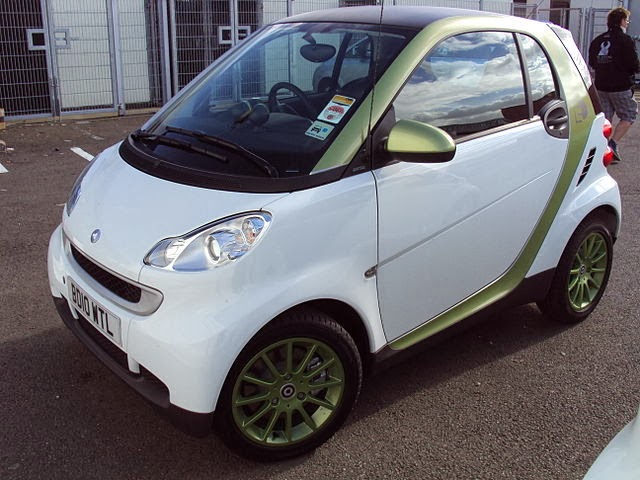
In recent years, concerns over global warming and the sustainability of fossil-fuelled transportation have led to the development of a number of hybrid electrical/petrol and fully-electrical vehicles, such as the hybrid Toyota Prius, the first generation of which was launched in 1997, and the fully-electrical Nissan Leaf, the first zero-emission car from a major manufacturer to reach the mass market. However, despite the recent activity and attention, the birth of the electric car came much earlier – the 1830s, in fact.
INITIAL DEVELOPMENTS
The initial invention of the electric vehicle has been attributed to a number of inventors. Hungarian Ányos Jedlik was responsible for the invention of an early type of electric motor in the late 1820s, and built a small model car powered by it.
Shortly after, an American inventor, Thomas Davenport, took his design of DC motor, and also powered a small model car around a short electrified track. A pair of Scotsmen, Robert Davidson and Robert Anderson, developed their own basic electric locomotives and carriages between 1832 and 1839, but the main limitation holding development back at this stage was the lack of a viable means of storing electricity on board the vehicle, in the form of rechargeable batteries. These did not emerge until the mid-1850s. A number of other variants followed, but it wasn’t until the 1890s that an electric car in the sense that we know it today appeared. This was developed by William Morrison of Iowa, and was a vehicle capable of carrying six passengers.
Following initial interest and development, electric cars began to lose ground to those powered by the newer internal combustion engine. Their low range meant they could not traverse long distances, and the development of improved road infrastructure required cars that could cover these distances. Petrol became more affordable, making internal combustion cars cheaper to operate over a distance, and the lack of public recharging facilities was another of the main limiting factors for the electric vehicle.
REVIVAL OF INTEREST DUE TO GLOBAL WARMING CONCERNS
The Western World went through two oil and energy crises in the 1970s and 1980s, and during these periods, and into the 1990s, scientific bodies began to express concern about the sustainability of transport systems based on the use of fossil-derived fuel, as in petrol (or gasoline). One of the major events that focused public attention on the direction that the motor industry would take was the unveiling in 1990 of General Motors’ Impact concept car, and their announcement of the intention to design and build electric cars for the general public.
A further energy crisis in the 2000s proved to be a tipping point, however, and this, along with increased public focus on energy saving solutions, brought about a significant jump in the sales of one of the high-profile hybrid vehicles, the Toyota Prius. Toyota had launched the Prius to some markets in 1999, to limited appeal, but the energy crisis, combined with its purchase, use, and sometimes public endorsement by high-profile Hollywood stars, sealed its popularity.
A number of other makers jumped on the bandwagon, with the release of other hybrid vehicles, and more time and money was given over to the development of fully-electrical vehicles.
The global recession of the late 2000s led to public demands that the motor industry scale back its production of large, fuel-inefficient vehicles, which some saw as symbolic or representative of the excesses which led to the recession in the first place, in favor of smaller cars in general, as well as hybrid and fully-electrical cars.
Models to have emerged since then include the Nissan Leaf, which was the first fully-electric zero-emission car to be produced for the general public by a major manufacturer, and the Tesla Roadster, first introduced in 2008. The Roadster was the first ‘highway capable’ electric vehicle to use lithium-ion batteries, and also the first production all-electric car to achieve more than 200 miles range from a single charge.
Every fall, the Sweet Greens family hits the road for a fall family trip. We usually spend a week in North Carolina, it is a great place to see the leaves change from green to the bright hues of Autumn. It is also perfect for pumpkin patches, winery’s, corn mazes, caramel apples, woolly worms, antique shopping, hiking, hot tubing and breathing in the cool smell of fall – and it isn’t too far away from our home.
Last year, we spent our fall family trip with our best friends in Bozeman, Montana. This was another amazing trip full of ghost tours, hot springs, Elk bugles, Yellowstone, candy stores, hot springs, amazing waterfall hiking, and zip-lining. Sharing fall with friends who are like family is the best!
This year, we want to incorporate camping into our fall family trip. Also, we want to stick closer to home, since Eben doesn’t want to miss a lot of school (he started a new one this year!) However, we also want to get a little of the things that we love about fall. Living in South Florida makes that tough! We don’t get the quintessential fall – we get a not-as-hot-as-summer fall. So our plans were to find somewhere North to camp – possibly St. Augustine again, however we decided to move that trip to December since they have amazing holiday lights and festivities.
Then, while lounging at the beach last weekend reading Florida Travel + Life magazine I came across an article on Gainesville. Gainesville is only a few hours drive from our front door, and is suppose to have a vibrant cultured, outdoorsy and creative community. It’s a college town (which we know we already love – remember we lived in Fort Collins, Colorado!) Here is the deal maker though, Gainesville has four seasons – a rarity in Florida, with brilliant foliage in late fall. And they even get frost from December to February – and sometimes snow too! What? I am super excited – the mister is busy finding the perfect spot to camp, and I am already daydreaming of our fall family trip!
Does your family take a fall trip? Do you have a go-to spot that you have to visit? Have you been to Gainesville – I would love to hear about your experiences, please leave your comments below!
Hello, Friends! This post wasn’t written by me. Thank you for supporting the companies that help to run Sweet Greens!
While many of us dream of an idyllic life in which we walk and cycle everywhere, loading our shopping into quaint panniers and hiking through the countryside on our days off, the reality for many people living in the modern age is that having a car is just a necessity of life. Whether you have a long commute to work, have children to take to school or friends and family in far-flung places, many people simply need a car in order to live their lives. The question is, can you own a car and still be green? By taking a careful look at your driving habits, you can work to minimize the impact you have on the environment by owning a car.
One thing that many car owners easily forget is that having a car doesn’t mean you have to take it everywhere! If you can, why not walk or cycle with the kids to school? It will stop you from getting caught in all the traffic at the school gates, and as an added bonus will help keep them fit and healthy too. And while many drivers struggle to relax with another person behind the wheel, getting over that fear and car-sharing with others is better for the environment and improves your social life to boot! Many workplaces have organized car-sharing options for people living in the same area, and if yours doesn’t why not set up your own? Similarly, if you’re planning a long journey, you can visit websites such as liftshare.com to team up with others looking to travel the same route. Not only will this save you money, it will help prevent unnecessary amounts of traffic from taking to the road.
When planning journeys, try to avoid peak times whenever you can. Getting stuck in long traffic jams uses up more gasoline, making your journey more expensive and worse for the environment. If you can, why not consider traveling at night? School holidays also mean more traffic on the roads in places like beaches and popular holiday attractions, so if you are able to be more flexible with your travel plans try and avoid these areas at these times. If you do need to travel at peak times to popular destinations, why not consider public transport as an alternative? You can pick up some great deals on trains if you book far enough in advance, and can avoid getting stuck in traffic jams.
Finally, which car you choose can make a huge difference in terms of impact on the environment. While electric cars and hybrids are popular choices among the eco-conscious, not everyone can afford the high price tags they come with. But there are some cheaper options too. Many eco-friendly models and are known for their commitment to bringing down CO2 emissions, while the Honda prices on carsales make the manufacturer’s range of environmentally friendly vehicles accessible even to those on a lower budget.
While it is undeniably a contributor to pollution, car travel is here to stay, at least for the foreseeable future. So, if you are a driver, make sure you do your part to reduce the impact you have on the environment by making responsible choices about your driving habits.
I am a huge thrift store shopper – I have been my entire life. I remember when I was little, I lived for hitting the thrift, antique shops and swap meets with my grandmothers. They taught me where and what to look for and how to haggle for the best price.
When I was a teenager, I purchased the majority of my quirky clothes from the thrift store. I never had to worry that someone would show up at a party or dance wearing the same dress I was. Ha! As an adult, I have honed the skill and am usually able to find exactly what I am looking for. My favorite things to look for are cookbooks, novels, quirky ceramic and pottery pieces, and expensive jeans.
Eben is getting quite good at thifting too, however he is more drawn to antique shops and comic books stores. Needless to say his favorite thing to look for is books. I usually have a hard time getting him to leave, he is usually sitting in a corner somewhere with a huge stack next to him.
Eben and I try to hit the thrift store at least once a week, I recommend going first thing in the morning before everything has been picked over and the store is still quiet. Yesterday, when we stopped I was on the lookout for new cookbooks for the mister.
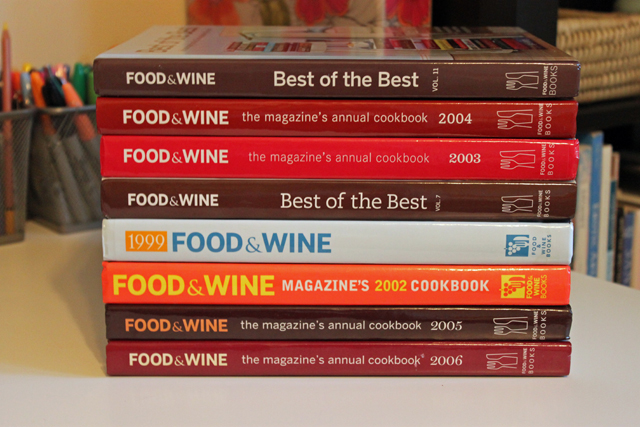
We are huge fans of Food & Wine magazine, so when I found 8 of their annual and Best of the Best cookbooks I knew I had to scoop them up. The mister was excited to have a new set of cookbooks, they are all in perfect condition and they look amazing on my media center – I love the colors! Here is a breakdown of the retail cost, what I paid and the savings.
Do you shop at the thrift store? What is your favorite thing to look for? Do you like these types of posts? I would love your thoughts – it helps me to decide whether to continue them.